
Parto (Comprehensive Financial System)

Parto (Comprehensive Financial System)
Financial management is one of the most important foundations of any business, especially in large organizations such as banks and credit institutions. The larger the organization, the more financial operations it has and the more complex its financial matters are. As the organization grows, the need to use powerful software tools to perform operations and manage financial affairs increases.
Financial managers of organizations, who are responsible for aligning financial matters with the growth of the organization, need a comprehensive, powerful, and efficient financial system that matches the size of the organization and the complexity of its financial matters to meet this growing challenge.
Parto is a comprehensive, centralized, scalable, and efficient financial system designed and developed using modern software development technologies and based on 40 years of Pooya Company’s experience in banking finance and the financial and software expertise of its specialists.
With the implementation of this system in the bank, integration in financial operations at the bank level is ensured, and the ease of communication between the bank’s departments and circles is guaranteed. This feature increases the accuracy and speed of financial operations and eliminates many potential user errors. Another achievement of this system is creating a flexible platform for generating various reports, especially those compliant with standards such as IFRS, to be presented to the Central Bank, the bank’s board of directors, and other departments in various formats.
Parto is a financial platform for large organizations and banks that minimizes human error by automating financial processes and, through the creation of up-to-date analytical reports, maximizes the ability to monitor the organization’s financial health and control cash flows.
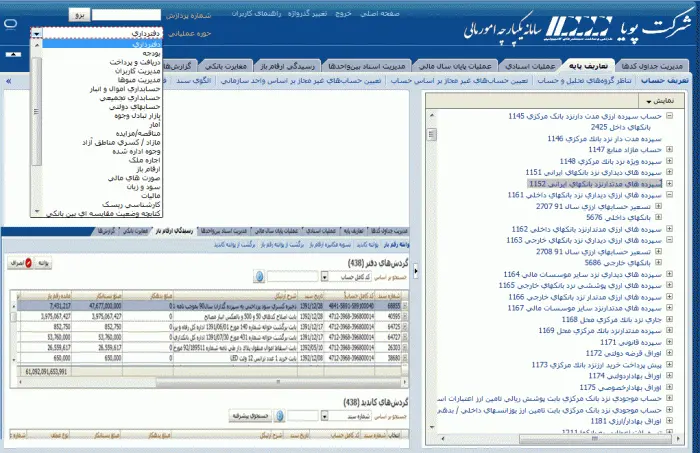
Subsystems Introduction
1. Bookkeeping System:
This system supports the recording and maintenance of the organization’s financial transactions with centralized control and separate ledger balances for each accounting unit. In the Parto bookkeeping system, by automating routines, the daily financial ledger closing is done in the shortest time and without errors. Monitoring financial performance in real-time and identifying and correcting errors before closing the daily financial ledger of each unit are among the capabilities that this system provides to financial managers of organizations.
2. Payment and Receipt System:
This system is responsible for managing the processes leading to payment and receipt of funds by recording and maintaining invoice and collection notice information. The Parto payment and receipt system is equipped with a document issuance engine. This engine converts payment and receipt information directly into financial documents for recording in the financial ledger after necessary audits and approvals. Completeness of information, accuracy, validity, record keeping, and transparency are among the significant elements for auditors and inspectors that the use of this system grants to the organization.
3. Transactions and Contracts System:
The Parto Transactions and Contracts System is a tool designed to ensure the complete achievement of each contract’s objectives within the organization. This system can maximize contract performance assurance through centralized controls, ensure compliance with commercial terms, report cash flow and the ability to meet financial obligations by contract deadlines, and reduce risk. Organizations using the Parto Transactions and Contracts System can centrally manage their tender, auction, price inquiry, and contract information, ensuring their financial health.
4. Inventory and Assets System:
The Parto Inventory and Assets System is designed to manage inventory and the flow of goods within the organization. Parto is a centralized system that helps organizations have reliable information about the exact location and usage conditions of assets at any time. The implementation of this system plays a significant role in reducing the cost of managing movable assets and improving their usage efficiency. Key features of this system include centralized definition and usage of various goods and asset tags, as well as direct integration with the Parto financial system.
5. Inventory and Assets Accounting System:
The Parto Inventory and Assets Accounting System is designed to perform inventory and assets accounting in a fully automated manner, either in direct connection with the Parto Inventory and Assets System or by receiving necessary accounting information from other inventory and asset systems and recording the related documents in the ledger.
6. Consolidated Accounting System:
The Consolidated Accounting System is responsible for receiving financial information from other systems used in the organization and integrating them into the organization’s standard account structure. Additionally, it prepares the organization’s general ledger balance information.
7. Central Bank Reports:
The Central Bank Reports System is specifically designed to prepare the required reports for the Central Bank from the information collected in the Consolidated Accounting System in XBRL format.
8. Personnel Accounting System:
The Parto Personnel Accounting System is designed and implemented to record, maintain, and report financial operations related to personnel, including salaries and wages, compensation, welfare funds, welfare affairs, insurance and taxes, and medical services. This system can receive information from other systems and issue documents based on dynamic settings using the document issuance engine.
9. Government Accounts Management System:
The opening, closing, and changing of authorized signatures of government accounts at bank branches are communicated by the Treasury of the Ministry of Economic Affairs and Finance to the bank’s general accounting department. The bank, while recording the history of government accounts, communicates the instructions for opening, closing, and changing the signatures of government accounts to the relevant branch. At the end of each day, the summary of transactions and the balance of government accounts at the bank’s branches are collected from the network level and, after consolidation, reported to the Central Bank. If the balance of government accounts increases or decreases compared to the previous day, the equivalent amount of the increase or decrease is withdrawn from or deposited into the bank’s account at the Central Bank. The Parto Government Accounts Management System is designed and developed to support these activities.
10. Managed Funds Management System:
Certain government institutions or large companies provide funds to the bank to allocate credit to their desired individuals, known as managed funds. The principal, interest, and late fees of these facilities belong to the fund-providing entity, and the bank charges a fee for the services provided. The allocation of facilities is done through branches, and using this system, the distribution and allocation of deposited funds to regional and provincial branch management and the collection of principal, interest, and late fees from regional and provincial branch management and their deposit into the Central Bank’s treasury account are facilitated. The Parto Managed Funds Management System is designed and developed to support this activity.
11. Budget System:
Proper management of credit consumption is one of the main concerns of managers in large organizations. In such organizations, this goal can only be achieved with centralized and integrated software with other areas. The Parto Budget Control and Credit Provision System prevents overspending by centrally controlling credit consumption in real-time, maximizing the oversight capabilities of budget managers. One of the significant features of the Parto Budget Control and Credit Provision System is the ability to request credit provision from units and track the provision from the time of request to consumption. The system also allows for the introduction of a hierarchical budget structure based on notifications, budget forecasts, budget allocation, and obtaining related reports, as well as reporting on deviations from the budget and performance variances.
12. Liquidity Exchange Market System:
Banks face the reality that some branches, due to various reasons such as geographic location, have more deposits than the loans they provide, leading to excess resources, while other branches face a shortage of resources. To optimize income from their capacities, banks seek a solution to balance resources between branches by creating a flow of resource transfer. Additionally, the bank’s treasury can invest in various portfolios in case of excess resources or finance from other capital markets, interbank borrowing, or borrowing from the central bank in case of resource shortages. The Parto Liquidity Exchange Market System, designed to assist banks in optimizing liquidity management, comes in two versions. The first version, titled “Inter-Branch Liquidity Exchange Market,” enables branches to trade with each other and transfer funds from resource-rich branches to resource-needy branches under the supervision and regulations of the treasury department by obtaining summary ledger information and future commitments of each unit. The second version, “Treasury Liquidity Exchange Market,” allows for the transfer of all branch surplus funds to the treasury department, which then covers the deficits of all branches. In this method, the treasury department, as the central financing hub, collects all funds centrally and distributes them among the bank’s units. At the end of the day, considering the overall bank surplus or deficit, the department can engage in various investments such as overnight loans to other banks or sourcing the deficit from external resources.
13. Financial Statements System:
Financial statements are reports prepared to represent and classify the financial information of the bank and are useful for a wide range of users in making important decisions. The components of a complete set of financial statements include the main financial statements and the accompanying notes and sub-notes. The Financial Statements System of the Parto platform can generate all the aforementioned components based on any standard required by the organization, including IFRS. This system, designed for use by banks and large organizations, is highly flexible against possible template changes by competent authorities, allowing users to produce notes, sub-notes, and changed items in their desired format by modifying their settings.
14. Tax System:
The Tax System of the Parto platform is designed to automate all tax-related matters, including generating reports and files required for submission to regulatory bodies such as the Tax Affairs Organization, managing tax payment matters, and preparing information for tax returns in compliance with the organization’s financial statements.
15. Insurance System:
The Insurance System of the Parto platform is responsible for recording and maintaining information on insurance contracts and managing related payment and receipt matters. This system, with its flexible definition of related processes and using a document issuance engine, has the capability to automatically issue documents for all insurance-related activities.
16. Legal Deposit System:
Banks are required to periodically submit summary ledger reports, assets and liabilities reports, and legal deposit reports in a format specified by the Central Bank. The Legal Deposit System is designed and developed to prepare these specific reports for banks.
17. Real Estate Lease System:
The Real Estate Lease System is designed and developed to manage rental payments for the organization’s leased properties and to manage the collection of rent for properties that the organization leases out. It also calculates the related taxes for each payment and receipt.
18. Cost of Funds System:
Profitability is one of the key functions of a bank. One way to achieve profitability is to increase resources and reduce the costs of acquiring these resources. Therefore, banks must acquire financial resources in a way that minimizes costs and, as a result, reduces the cost of funds. In today’s world, factors such as industrialization, the expansion and transformation of social activities, and the emergence of new needs are important factors in the creation and expansion of financial institutions. The presence of advanced financial institutions and markets, along with the use of modern methods, has made the banking business increasingly competitive. In these circumstances, how financial resources are combined and the costs of each, as well as their impact on the cost of funds, are issues that financial and credit institutions have always considered. Institutions are in constant competition to attract more financial resources. Currently, in addition to striving to develop and expand and find ways to increase profitability, banks must combine financial resources in a way that reduces costs and achieves their main goal of profitability. Therefore, banks must calculate various costs and choose the paths that lead to the lowest costs. A bank can succeed in this important task if it can always perform cost calculations quickly and accurately with accurate financial data and make related decisions with agility and correct information. The Cost of Funds System, using information from the bank’s consolidated ledger system, can perform cost of funds calculations in less than a few seconds and provide the relevant reports.
19. Financial Reports of Organizational Units:
In some large organizations, there are operational units whose financial performance needs to be independently reviewed and compared with other units. For example, banks need to be able to compare the financial reports of their branches or branch management. The Financial Reports System for Organizational Units prepares and presents the financial statements of the organizational units separately.
20. Stock Market Settlement Assistant:
In simple terms, transaction settlement refers to the transfer of securities and money between the buyer and seller of a share through a brokerage. Each individual needs a user account with a brokerage to trade. Each trade has direct and indirect parties. The direct parties are the buyers and sellers of a symbol during trading hours on the stock exchange, while the indirect parties are the brokers of the buyers and sellers. After transactions are made, the money and the bought and sold shares are transferred between the buyer’s and seller’s brokers. This process is called transaction settlement.
The number of brokers and the volume of transactions in the stock market are very high. Therefore, an intermediary institution is needed between the trading brokers to ensure that transaction settlements are carried out correctly and easily. This role in the capital market is performed by the Central Securities Depository and Settlement Company (CSDC).
The transaction settlement process works as follows: After a trade is made between a buyer and a seller, the funds are transferred from the buyer’s broker to the CSDC system and then to the seller’s broker account. Transaction settlements are completed three working days after the trade (T+3).
If a trade is not settled within the specified time (three working days), the buyer has up to seven days after the settlement deadline to pay the required amount and complete the settlement. However, a penalty fee is applied for each day of delay, calculated as a percentage of the trade value.
To reduce the risk for shareholders and the capital market, based on a tripartite agreement between the bank, the CSDC, and the brokerage, the bank daily inquires about the brokerage’s debt from the CSDC and settles it. To cover the brokerage’s debt, if the brokerage’s bank account has sufficient funds, the required amount is deducted from the brokerage’s account. If the account does not have sufficient funds, the bank covers the shortfall and considers it as a loan to the brokerage.
The Stock Market Settlement Assistant System is established in banks to facilitate the daily settlement of broker transactions with the CSDC. The main functions of the Stock Market Settlement Assistant System include inquiring about the debts of contracted brokers from the CSDC, maintaining their financial information, and providing the necessary information to the bank’s operational systems for performing related banking settlement operations.
21. Stock Market Bank Assistant:
In today’s highly competitive financial services market, gaining an edge is both crucial and challenging. For banks to succeed in this competition, they need to study and analyze the strategies of their competitors. The Stock Market Bank Assistant of Parto facilitates this process by collecting and analyzing the monthly performance of publicly listed banks, making competition easier for the bank and saving time for bank staff in preparing various reports.
The primary function of the Stock Market Bank Assistant system is to prepare analytical reports, which are done in two main stages: information collection and information analysis.
In the first stage, the monthly performance data of publicly listed banks, published at a specific time on the Codal website (the comprehensive information disclosure system of the Securities and Exchange Organization), are automatically retrieved, eliminating the need for human resources to collect this information.
In the second stage, using the system’s reports, which are available in various charts and formats, with criteria and inputs tailored to the type of report required, and outputs matching the user’s needs, data analysis is performed quickly and easily. The system also allows users to customize the reports.
This system offers a high variety of reports in visual chart formats regarding the performance of resources and expenditures and the calculated ratios of publicly listed banks. One part of this system is responsible for tasks such as data collection, control, and correction, while the other part handles more specialized tasks such as performance calculations, financial ratios, and report preparation.